Symposium 2026 Recap: Prepaid as the Backbone Powering Canada’s Next Payments Era

On April 23, 2026, the CPPO marked its 10th annual Symposium by bringing together leaders across prepaid, banking, fintech, policy, fraud, loyalty, and investment to examine where Canada's payments ecosystem is headed next.
Across the day, one theme came through clearly: prepaid is no longer just cards; it is the infrastructure powering neobanks, embedded finance, cross-border innovation, and faster money movement across Canada.
As real-time rail readiness, open banking, stablecoins, RPAA implementation, and AI-driven commerce reshape the market, Symposium 2026 positioned prepaid as the connective tissue of modern money movement in Canada's increasingly multi-rail reality.
The program also focused on where prepaid’s competitive edge is evolving next, from agentic commerce and security threats like deepfakes and synthetic identities to personalized rewards, B2B payments modernization, and investor interest in AI-enabled, embedded, and regulation-resilient fintech models.
The prepaid rail is the underlying infrastructure making multi-banking possible. It's not just a product. It's the architecture behind some of the most important financial tools Canadians are choosing right now. - Jennifer Tramontana, CPPO Executive Director

Jennifer Tramontana, CPPO Executive Director and CPPO Board Chair, Kartik Kamat, Vice President of Product Management at Mastercard, opened the day by framing prepaid as a central enabler of Canada's financial modernization, not only as a product but as infrastructure beneath the multi-bank experiences Canadians are already building.
That framing carried throughout the event: prepaid's role now spans neobank growth, embedded finance, cross-border innovation, emerging multi-rail strategies, and the trust layers needed as AI begins reshaping commerce.
The opening remarks also emphaszied the importance of collaboration across issuers, networks, fintechs, regulators, and policy leaders as payments, banking, and commerce continue to converge.
Key takeaways:
Prepaid has moved from niche to infrastructure in Canada's financial services landscape
Canadians are increasingly building multi-bank financial lives, and prepaid is helping make that model work
The next phase of innovation will depend on alignment across product, policy, and ecosystem partners.
Why Prepaid Still Wins

Moderator
Brian Tate, President and CEO, IPA
Speakers
Asad Saeed, Head of Client Partnerships & Growth, ABCorp
Hamza Khan, Director, Consumer Cards, Visa
Cato Pastoll, Co-Founder & CEO, Loop
Kate Sullivan, Vice President, Global Consumer Products, Blackhawk Network
The opening panel made the case that prepaid still “wins” because it solves for speed, certainty, control, and launch-readiness in a market that remains operationally and regulatorily complex.
Speakers repeatedly returned to the idea of “good funds” and instant utility, arguing that prepaid now underpins everything from earned wage access and gig payouts to cross-border treasury movement, insurance payments, refunds, government disbursements, and multi-currency travel.
The panel also added useful nuance on why prepaid still matters operationally: it gives challengers a faster path to launch regulated experiences, lets providers keep rail complexity hidden from the customer, and increasingly works best when embedded so seamlessly that the end user barely perceives it as prepaid at all.

Regulatory clarity came through as another major theme, with panelists suggesting that a more consistent Canadian framework would shift competition toward customer experience and product quality rather than fragmented compliance workarounds.
Key takeaways:
Prepaid gives fintechs and enterprises a faster path to market for regulated financial experiences in Canada.
Good-funds models and instant utility remain core advantages, especially for gig payouts, earned wage access, rewards, and cross-border use cases.
Prepaid is increasingly less visible to the end user and more valuable as a programmable infrastructure layer in the background.
Regulatory clarity, especially under emerging Canadian frameworks, is seen as a catalyst for more innovation rather than a barrier.
Inside the 'Neo' Normal: How Canada's Digital Banks Are Shaping Financial Services

Moderator
Balinder Ahluwalia, SVP Market Development and Group Head, Mastercard
Speakers
Adriana Iglesias Romero, Director, Payments Compliance and Operations, Wealthsimple
Daljit Singh, Head – B2B Payments & Partnerships, EQ Bank
Ryan Tevel, VP of Partnerships and Business Development, KOHO
Raveen Sangha, VP Strategic Partnership & Client Success, Peoples Group
This panel explored how neobanks have evolved from disruptors into a core part of Canadian consumers' financial lives, supported by the broader shift toward challenger adoption and multi-bank behavior in Canada.
Speakers walked through how different models entered the market, from Wealthsimple's investment-first path to EQ Bank's digital-banking buildout, KOHO's fee- and credit-access thesis, and Peoples Group's role as invisible infrastructure for fintech launches.
Across those examples, the through line was that prepaid helped many of these players launch and scale quickly, but the winning model today is broader: faster digital onboarding, better service, stronger day-to-day utility, and a more seamless connection between spending, saving, investing, borrowing, and account movement.

The session also made clear that the next competitive battleground is depth of relationship, with digital banks trying to become primary financial partners rather than secondary accounts while operating within a more demanding regulatory and infrastructure environment.
Key takeaways:
Neobank growth reflects a real shift in consumer behavior, with more Canadians maintaining relationships across both traditional and digital providers.
Prepaid helped digital banks launch quickly, but its role is now expanding into a broader banking and payments infrastructure function.
User experience remains a major differentiator, from onboarding and customer support to spending controls and financial visibility.
The future direction points toward deeper engagement, broader product stacks, and more embedded payment capabilities.
The Agents Are Here: Preparing for the Next Era of Commerce

Speaker: Jon Bromstein, Head of Digital Performance & AI Consulting, Visa
This keynote focused on how AI is moving from insight generation into execution, creating the conditions for agentic commerce where software agents can assist with shopping, decisioning, and payment initiation.
The message was that this shift is not just about AI novelty; it is about rethinking how commerce systems will need to support intent, orchestration, and trust. That framing connected directly to one of the day's core questions: how agentic commerce could reshape transactions while also raising new security and verification challenges.
Key takeaways:
AI's impact on commerce is becoming operational, not just analytical.
Agentic commerce will require new controls around trust, transparency, and authorization.
Payments providers should be preparing now for workflows where agents influence or execute customer decisions.
Beyond Points: Turning Payment Data into Hyper Personalized Reward Experiences

Moderator
Manuel Catedral, VP Business Development, Collinson Group
Speakers
Dina Vardouniotis, CEO, Payments and Partnerships
Maria Riesenberg, VP, Product Management, Mastercard
Ed Woodson, Chief Legal Officer, Onbe
This session examined how payment data is reshaping loyalty from a static points-and-redemption model into a more personalized, contextual, and always-on value exchange.
Speakers argued that loyalty is no longer just about accumulating points or miles; it is about creating emotional connection, delivering everyday value, and using transaction insight to show up in moments that feel relevant rather than generic.
A particularly strong theme was timing: panelists noted that issuers are already excellent at real-time fraud decisions but often still lag badly on real-time engagement, even though the greatest opportunity may sit in the first months of a customer relationship when habits, top-of-wallet behavior, and spend patterns are still forming.

The discussion also surfaced the legal and reputational edge of hyper-personalization, with the group emphasizing that useful personalization can quickly become “creepy” if consent, transparency, and contextual fit are missing.
Key takeaways:
Loyalty is shifting beyond points toward experiences, contextual value, and more adaptive engagement models.
Payment data can improve lifecycle marketing, especially in the first 6 to 12 months of a customer relationship.
Real-time or near-real-time data access is critical if issuers want to trigger relevant offers at the moment they matter.
Personalization must be balanced with consent, privacy, and the risk of becoming intrusive or “creepy.”
Deepfakes and Dollars: Strengthening Payments Security in the Age of AI

Moderator
Milos Dunjic, Payments Innovation & Tokenized Payments Enablement Practice Lead, TD Bank Group
Speakers
Andrew Johnston, Digital Trust Executive, Giesecke+Devrient
Dan Dusto, Unit Commander, Ontario Provincial Police
Paul Twigg, CTO, Digital Commerce Bank
This panel focused on the growing threat landscape created by deepfakes, synthetic identities, account takeover, and AI-assisted fraud, with speakers arguing that the real target is not just a payment system but trust itself.
The conversation blended law-enforcement and industry perspectives, including a concrete example from policing work in which AI-enabled fraud detection and blockchain analysis were used to proactively identify victims before additional losses occurred.
Panelists repeatedly stressed that Canada's challenge is not just better point tools, but stronger cross-institution intelligence sharing, better anomaly detection, and authentication models that move beyond outdated password-first approaches.

Another important theme was “Goldilocks” friction: institutions need enough intervention to interrupt manipulation and urgency-driven scams, but not so much friction that legitimate customers are trained to route around the safeguards or abandon trusted providers.
Key takeaways:
Deepfakes are dangerous because they exploit human trust, not just technical vulnerabilities.
AI-powered fraud requires AI-powered defense, particularly around anomaly detection, cross-silo intelligence sharing, and identity verification.
Canada’s account takeover problem remains significant, and stronger authentication is a pressing need.
Institutions need to strike the “Goldilocks” balance on friction: enough to stop fraud, but not so much that legitimate users are pushed away.
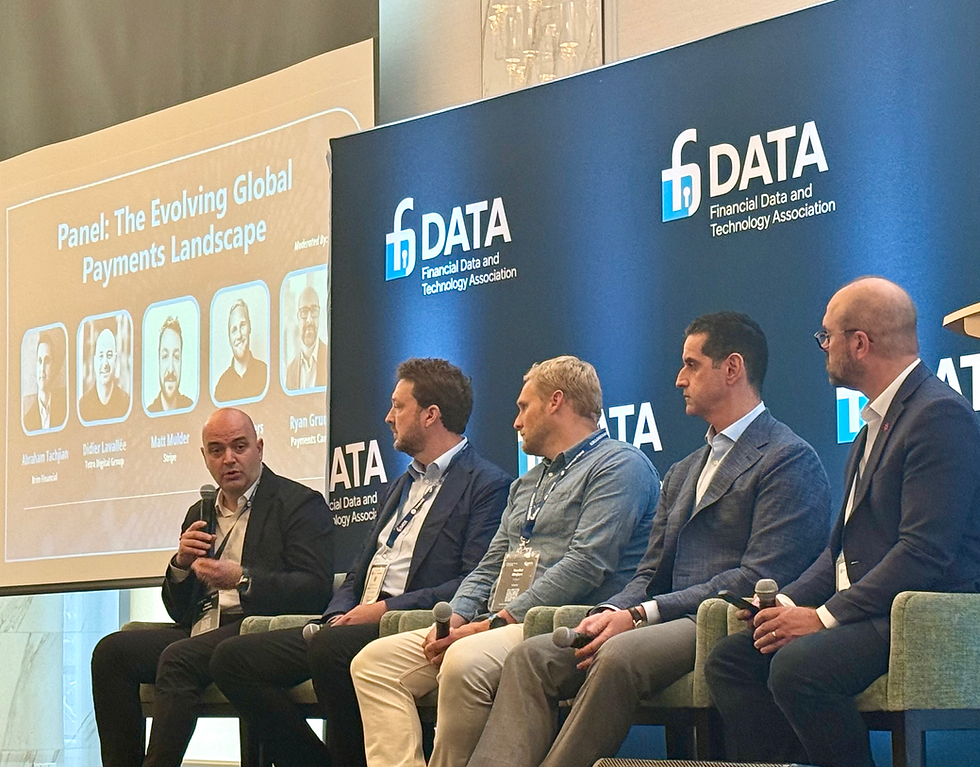
The Great Rail Shift: Competing and Coexisting in Canada's Real-Time Economy

Moderator
Claire Brownell, Reporter, The Logic
Speakers
Abraham Tachjian, Chief Regulatory Affairs Officer, Brim Financial
Will Keliehor, Chief Client Officer, Peoples Group
Eric Richmond, General Counsel & Head of Business Development, Shakepay
Sander Meijers, Country Manager, Adyen
This discussion centered on how prepaid, RTR, stablecoins, and existing bank rails may compete, complement, and coexist in the next era of Canadian payments.
Panelists largely rejected the idea that one rail will “win” outright, instead describing a market where rails coexist and providers are responsible for abstracting that complexity away from users based on use case, cost, speed, settlement needs, and trust.
Several examples grounded that argument: prepaid remains important for acceptance, inclusion, government disbursements, and customer familiarity; RTR promises better funding and settlement control; and stablecoins appear especially interesting for cross-border movement, 24/7 availability, programmability, and finality-sensitive use cases.

Just as importantly, the panel highlighted that policy access matters as much as technical plumbing, since a more open and workable regulatory framework determines which new players can actually participate in the next generation of rails.
Key takeaways:
The future is multi-rail, and the real challenge is orchestration rather than replacement.
Prepaid remains highly relevant because of its acceptance, customer familiarity, and role in funding, disbursement, and inclusion use cases.
RTR can strengthen prepaid experiences by improving funding and settlement, rather than displacing them.
Stablecoins are gaining attention, particularly for cross-border and always-on settlement use cases, but trust, usability, and market readiness remain key questions.
Turning Complexity into a Competitive Edge: Modernizing B2B Payments in Legacy-Heavy, Highly-Regulated, Specialty Markets

Moderator
Pamela Draper, President, Digital Commerce Payments
Speakers
Alice Reimer, CEO, Fillip Fleet
Kora Licht, Director Sales Enablement, TreviPay
This session highlighted how innovation often matters most in categories that are still burdened by complex workflows, fragmented systems, and regulatory weight.
Speakers described specialty B2B environments where businesses still run on legacy processes, fragmented approvals, magstripe-era controls, manual onboarding, and payment experiences that feel far behind modern consumer expectations.
The recurring message was that the opportunity is not simply to digitize a payment, but to redesign the surrounding workflow: move compliance into the background, bring more intelligence into authorization decisions, reduce fraud, simplify onboarding, and surface the right operational data so customers can act on it.

The panel also showed that modernization often works best when introduced incrementally around a visible pain point, proving ROI first and then expanding trust, automation, and digital adoption over time.
Key takeaways:
B2B payments modernization is often less about flashy new rails and more about removing friction from entrenched workflows.
Legacy-heavy verticals offer significant room for innovation when payments are integrated into operational systems.
Complexity can become a competitive advantage when providers simplify compliance, invoicing, and money movement for customers.
Prepaid, But Programmable: Trust, Control, and the Rise of Agentic Commerce

Speakers
David Kormushoff, VP of Technology, AI & Platform, KOHO
Tom Pawelkiewicz, Vice President, Product Management, Mastercard
This session brought the day's AI and commerce themes back to prepaid, asking whether prepaid could become the safest and most practical foundation for agentic commerce.
Speakers made a strong case that prepaid users are already primed for this shift because they think in terms of buckets, budgets, and controlled purposes for money, which maps naturally to delegated agent activity rather than broad autonomous authority.
The panel framed the real challenge as trust architecture, not technical feasibility: verifiable intent, scoped permissions, continuous monitoring, and “Know Your Agent” standards all emerged as essential controls if agent-led spending is going to scale safely.
The speakers also noted that companies should first build internal AI muscle and defensive use cases, especially around fraud and transaction monitoring, before rushing to launch thin customer-facing AI features with weak safeguards.

Key takeaways:
Agentic commerce is better understood as delegated action, not full autonomy.
Prepaid is well-suited to early agentic commerce use cases because it already supports scoped value, visibility, and control.
“Know Your Agent,” verifiable intent, continuous monitoring, and transparent customer controls will be critical trust mechanisms.
The industry has an opportunity to establish standards proactively before heavier regulation arrives later.
Where the Smart Money’s Going: How Investors are Preparing for Fintech’s Next Act

Moderator
Michelle Beyo, CEO & Founder, Finavator
Speakers
Jonathan Dellar-Fernandes, Principal, Venture Capital, National Bank of Canada
Taha Mubashir, Partner, Inovia Capital
Tal Schwartz, General Partner, North Exit Ventures
Peggy Van De Plassche, Venture Capitalist & Author, PVDP Advisory Services
The final panel widened the lens to capital flows, entrepreneurship, and Canada's innovation competitiveness. The discussion was more urgent than celebratory, tying venture deployment to concerns about founder flight, concentration of capital, regulatory drag, and the country's shrinking pool of entrepreneurs relative to its population growth.
Investors noted that capital is concentrating in fewer firms and later-stage companies, while early-stage founders still face a harder environment in Canada, particularly in regulated fintech categories where compliance costs and uncertainty raise the bar to building.

Even so, the tone was not purely pessimistic: panelists pointed to opportunity in AI-forward companies, infrastructure plays, and fintech businesses that solve real structural problems, while arguing that clearer rules, stronger ecosystem support, and more risk-tolerant capital are still needed if Canada wants more globally scaled winners.
Key takeaways:
Investors remain focused on the future of finance, but the ecosystem needs stronger support for entrepreneurship and scaling in Canada.
Payments modernization, including open banking and faster rails, is increasingly viewed as an investment and competitiveness issue, not just an infrastructure one.
Capital is looking for businesses that solve real structural problems in finance and commerce, not just incremental feature plays.

Wrapping up Symposium 2026
CPPO Boar Chair, Kartik Kamat closed out the day with a few remarks:
"We set out this morning to have the conversations that matter most for this industry right now and I think we delivered."
What strikes me about every CPPO Symposium is that the most important moments happen at the edges of the program: in the hallway after a panel, over lunch, at the reception. The connections made today — between a program manager and a neobank, between a compliance team and a regulator, between a founder and an investor — those are what move this industry forward.

"On the multi-rail reality: the question is no longer whether prepaid remains relevant but it's about knowing precisely when and why it's the right rail, and making sure our products and programs are built to win in that environment.
On AI: the opportunity is real, and so is the pressure to get it right. The organizations in this room are the ones who will define what responsible AI adoption looks like in Canadian payments.
On regulation: the landscape is shifting, and CPPO will continue to be in those rooms at the Bank of Canada, at Finance, at the provincial level making sure the rules that shape this industry reflect how it actually works.
And on the broader Canadian economic moment: there's a real opportunity here. As Canadians look for homegrown alternatives and domestic financial tools built for their lives, this industry is positioned to deliver. Let's make sure we do."


Comments